


Tax Reform Has Repriced Australian Property; but It Has Not Rewritten the Fundamentals

Why affordability, credit, location, scarcity and buyer preference will determine which properties perform after the 2026–27 Federal Budget
Jeremy Faul
That Real Estate Guy | August 2026 | Property Investment Specialist
THAT REAL ESTATE GUY | MARKET INSIGHT
Australia’s property market has entered a new phase of price discovery.
The 2026–27 Federal Budget did not abolish negative gearing altogether. From 1 July 2027, negative gearing will generally be limited to newly built residential property. Established investment properties held before 7:30 pm on 12 May 2026 are grandfathered. For established residential property acquired after that time, excess rental losses will generally be quarantined against residential property income rather than deducted from salary and wages. The Budget also changes the capital gains tax framework, with special transitional treatment and choices for qualifying new builds.
These changes alter the relative economics of new and established investment property. But they do not mean that every new dwelling has become a good investment or that every established dwelling must decline by the same amount.
The property market is not one market. It is a collection of local markets, price brackets and property types, each supported by a different combination of investors, first-home buyers, owner-occupiers and downsizers.
The central question is therefore not simply whether negative gearing is available. It is how much the tax benefit is worth after the market has priced it in—and whether it compensates the purchaser for the property’s location, land content, rental return, competing supply and future resale demand.
The affordable market is finding a new equilibrium
The current correction is partly monetary and partly thematic.
It is monetary because interest rates, bank serviceability assessments and debt-to-income limits determine what buyers can actually borrow. APRA requires lenders to assess housing loans using a serviceability buffer of at least three percentage points above the loan rate. It has also introduced limits on the proportion of new lending that can be written at high debt-to-income ratios. These settings affect highly leveraged and higher-priced purchases more than transactions requiring smaller loans.
It is thematic because the Budget has changed the relative appeal of different housing products. Investors who want access to negative gearing will be encouraged towards qualifying new construction. At the same time, owner-occupiers—who do not receive a negative-gearing benefit on their home—will continue to choose according to price, location, land, amenity, schools, employment, transport and lifestyle.
Those forces meet in the affordable market. As borrowing capacity tightens, demand does not necessarily disappear; it can migrate to lower price points, smaller dwellings and more affordable locations.
Cotality’s July 2026 figures illustrate this divergence. National upper-quartile home values fell by 3.2% over the three months to July, while the lower-priced quartile recorded a 0.3% increase. That does not establish a universal threshold at $1 million, but it demonstrates that the market is not correcting evenly. Affordability is acting as a source of relative support at the lower end.
A tax benefit can be capitalised into the purchase price
Negative gearing has an economic value, but it is not free value.
When government policy gives one class of property a tax advantage, part of that advantage can be captured by developers or landowners through a higher selling price. The purchaser may receive a larger future deduction while paying more upfront for the asset.
This is particularly important when comparing a new dwelling with an established alternative. The correct comparison is not:
New property with negative gearing versus established property without it.
It is:
Total purchase price + finance cost + rental income + tax position + land content + location + competing supply + risk + future resale demand.
A new property may offer depreciation benefits, lower initial maintenance and continued access to negative gearing. But those benefits may be partly offset by a new-build premium, a smaller block, lower initial yield, construction or completion risk, strata costs, or a location where substantial additional supply can be released.
Conversely, an established property may have less favourable tax treatment for a new investor, yet offer a lower purchase price, a smaller cash shortfall, more land, established infrastructure and stronger owner-occupier resale demand.
Tax efficiency and investment efficiency are not necessarily the same thing.
The Warrawong test: what is the marginal buyer actually choosing?
Consider a practical choice in the Illawarra.
One option is an established double-brick house in Warrawong on approximately 491 square metres. It is closer to Lake Illawarra, Port Kembla, Wollongong employment, established transport, shops and community infrastructure. Its purchaser may need to undertake improvements and account for the suburb’s industrial perception, flood exposure on particular sites and the maintenance requirements of an older dwelling. A post-Budget investor may not receive the same negative-gearing treatment available to a qualifying new build.
The alternative is a brand-new brick-veneer house in an inland growth area west of Lake Illawarra. It may offer modern design, lower initial maintenance, energy efficiency and access to the new-build tax treatment. However, it may sit on a smaller parcel of land, further from the coast and established employment, with infrastructure still being delivered and more competing lots and dwellings capable of entering the market.
Which property should be worth more—and which should appreciate faster?
There is no automatic answer. The market must price the complete bundle of benefits and disadvantages.
The new dwelling must provide enough value through tax efficiency, newness and lower maintenance to compensate buyers for any new-build premium, smaller land component, distance and future competing supply.
The established Warrawong property must trade at a price that compensates an investor for its reduced tax treatment, age and site-specific risks. But it may also benefit from finite established land, replacement-cost support and demand from owner-occupiers who place no value on negative gearing because they intend to live in the property.
That last point is fundamental. The resale value of a property is not determined solely by investors. A property with broad owner-occupier appeal can retain a deeper future buyer pool than a product designed primarily around investor incentives.
Location and supply elasticity still matter
Urban economics tells us that households pay for access and amenity. Proximity to employment, transport, coastlines, waterways, established services and desirable lifestyle features can become capitalised into land values.
However, a premium location is not automatically a superior investment at any price. If the amenity premium is already excessive, the property may deliver a weak rental yield and become more sensitive to changes in credit conditions. Waterfront and coastal locations can also carry flood, erosion, insurance and maintenance risks that must be assessed property by property.
Growth corridors present the opposite trade-off. They can benefit from population growth, new infrastructure, schools, retail and improving connectivity. A lower starting price can also create room for catch-up growth. But where land is progressively released, new supply gives buyers substitutes. That can restrain the scarcity premium until the area matures and the supply pipeline tightens.
The NSW Government identifies West Lake Illawarra as a regionally significant growth area, and infrastructure investment is intended to support thousands of additional dwellings. That is positive for population and amenity, but it also confirms that buyers must examine the volume and timing of competing supply.
The relevant distinction is supply elasticity: how easily can another comparable dwelling be produced nearby?
An established house on a meaningful parcel of land in a geographically constrained location may be difficult to reproduce. A house in a large release area may be attractive and well designed, but its capital growth will partly depend on how quickly demand absorbs future stages of development.
Australia still has a physical housing-supply problem
The Budget seeks to redirect investor capital towards new dwellings. That objective is understandable: the Government has stated that more than 80% of new investor lending had been flowing into existing homes rather than adding to housing stock.
But a tax incentive cannot by itself manufacture serviced land, qualified tradespeople, development finance or completed dwellings.
Australia completed 43,816 dwellings in the March quarter of 2026 on a seasonally adjusted basis, a decline of 0.4% from the previous quarter. The National Housing Supply and Affordability Council previously recorded 177,000 dwelling completions in 2024 against estimated underlying demand of approximately 223,000 homes.
Building approvals improved to 18,328 dwellings in June 2026, but an approval is not a home. A project must still secure funding, presales where required, labour, materials, infrastructure and a selling price that compensates the developer for risk.
If investors withdraw from established rental property faster than new housing can be completed, the pressure may appear through reduced rental choice and higher rents rather than through a uniform collapse in established values.
Scarcity is therefore relevant—but scarcity alone is not an investment strategy. It must be accompanied by sustainable demand and the capacity of households to pay.
Replacement cost provides an important reference point
Established housing should also be compared with the economic cost of producing a substitute.
The replacement equation includes land, construction, professional fees, approvals, infrastructure contributions, finance, holding costs and a development-risk margin. Where that total materially exceeds the price of an established property, new supply may not be able to enter at a lower price.
This does not create a guaranteed floor beneath every established dwelling. An obsolete building, compromised site or weak location can still underperform. But replacement cost helps explain why selected established houses can remain resilient even when investor tax treatment becomes less favourable.
It also exposes the danger of treating a tax deduction as a substitute for value. Paying a substantial premium for a new property to obtain a future tax deduction may be economically inferior to purchasing a better-located established asset at a lower price and accepting a smaller deduction.
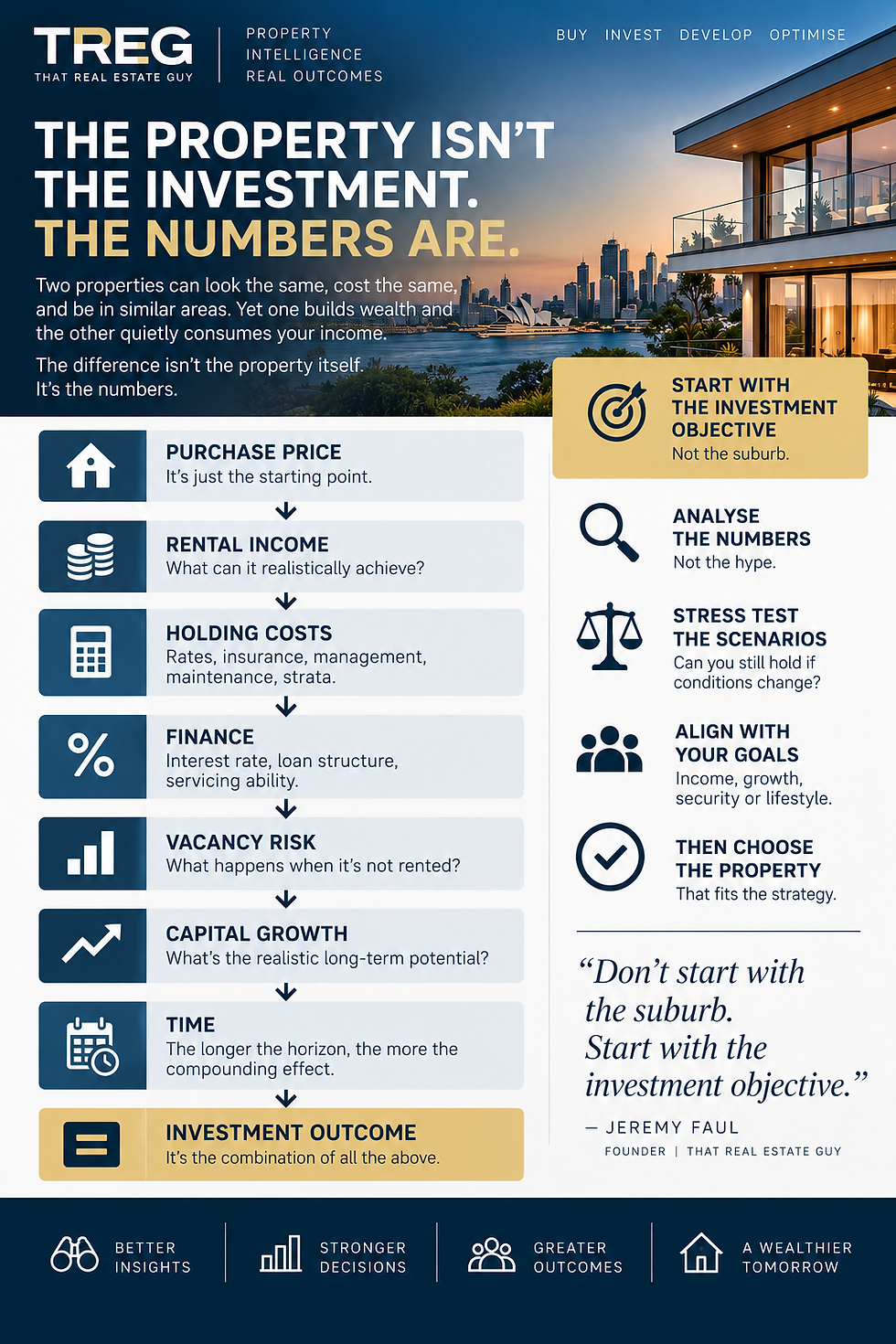
The numbers must be tested, not assumed.
How to read the post-Budget market
The most useful indicators will be those that reveal where demand, credit and supply are moving before they appear fully in median prices:
Housing finance approvals and investor loan commitments.
Borrowing capacity and lender credit-policy changes.
Listings, days on market and vendor discounting by price bracket.
Price movements across lower, middle and upper quartiles.
Rental vacancy, achievable rent and tenant affordability.
Building approvals, commencements and completions.
Construction, land and infrastructure costs.
Population, employment and household formation.
Owner-occupier versus investor participation.
The future supply pipeline for the specific property type and location.
The analysis must then return to the individual asset. Who wants to live there? Who can afford it? How many alternatives exist? What would it cost to reproduce? Who is likely to buy it at resale?
The emerging investment principle
The Budget has changed the relative price of tax efficiency, but it has not rewritten the fundamentals of property performance.
The affordable market is moving towards a new monetary and thematic equilibrium. Credit determines the buyer’s spending limit. Tax policy changes the relative appeal of new and established dwellings. Location, scarcity, rent, land and lifestyle determine which properties retain enduring demand.
For the investor comparing a new house in an inland growth corridor with an established house on 491 square metres in Warrawong, the question is not whether negative gearing is available. The question is whether the value of that tax treatment exceeds the value of the location, land and scarcity being surrendered—or vice versa.
New property will not automatically outperform because it receives a concession. Established property will not automatically outperform because it is scarce. Long-term performance will belong to properties where the purchase price, holding economics and underlying demand characteristics remain aligned.
In a fragmented post-Budget market, broad predictions will become less useful. Asset selection—and understanding the reason people will continue to choose one location over another—will matter more.
About the author
Jeremy Faul is a licensed real estate agent, buyer’s agent and property investment specialist, and the founder of That Real Estate Guy.
Important information
This article provides general property-market commentary only. It does not constitute financial, taxation, legal or credit advice, and it does not recommend any particular property or investment strategy. Tax outcomes and borrowing capacity depend on individual circumstances. Readers should obtain independent advice from appropriately licensed financial, taxation, legal and credit professionals.
Sources
Australian Government, Budget 2026–27: Tax Reform
Australian Government, Negative Gearing and Capital Gains Tax Reform
Australian Prudential Regulation Authority, APG 223 Residential Mortgage Lending
Australian Prudential Regulation Authority, High Debt-to-Income Home Lending Limits
Cotality, Australia’s Housing Market Downturn Widens, August 2026
Australian Bureau of Statistics, Building Activity, March 2026
Australian Bureau of Statistics, Building Approvals, June 2026
National Housing Supply and Affordability Council, State of the Housing System
NSW Government, Illawarra Shoalhaven Regional Plan 2041
NSW Government, Housing Acceleration Fund—West Lake Illawarra
Reserve Bank of Australia, Housing, Coastal Cities and Amenity
Jeremy Faul | Property Investment Specialist |



Comments